
A Brief Background
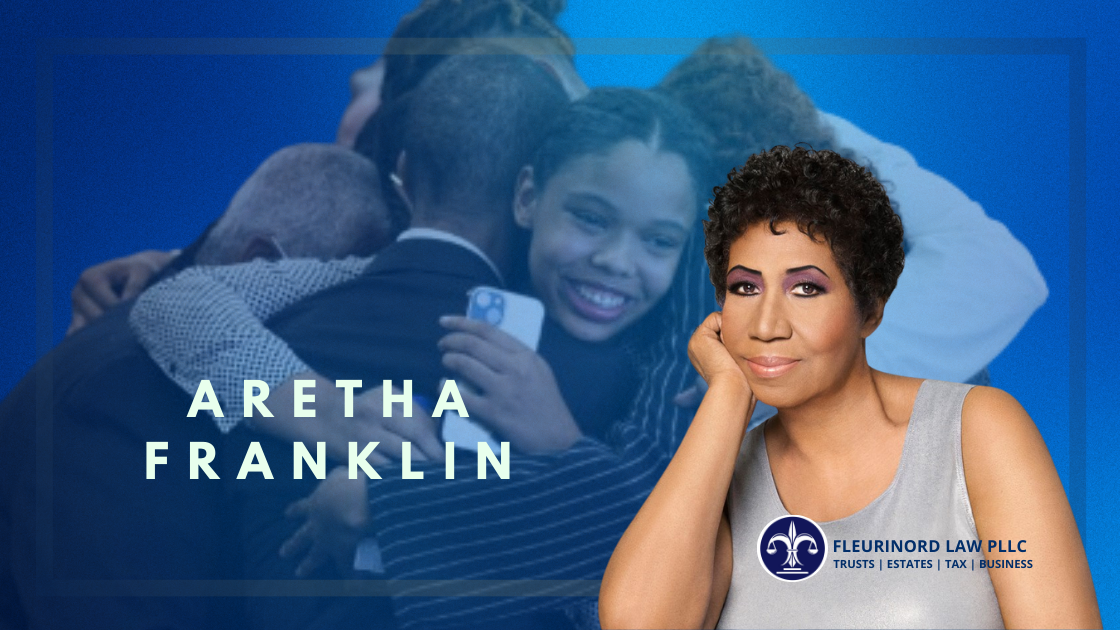
Aretha Franklin, the legendary Queen of Soul, passed away on August 16, 2018 from pancreatic cancer at the age of 76 in Detroit, Michigan. She left a legacy marked by her incomparable music and talent, and a $6 million estate comprising real estate, cash, gold records, furs and her music copyrights. However, Aretha’s estate has been mired in complications and disputes among three of her four sons. Aretha’s oldest son, Clarence Franklin (born in 1955) has special needs; he is under legal guardianship and is not involved in the probate case. Her other sons are Edward Franklin (born in 1957), Theodore “Teddy” White, II (born in 1964); and Kecalf Franklin (born in 1970).[1]
This estate showcases a drama-filled example of what can happen when your intentions are unclear, and you never bother to have your estate plan drafted by a licensed attorney. In the July 2023 trial, her sons were at odds about which of her two handwritten wills would govern her estate.[2] Kecalf and Edward favored the 2014 will, while Teddy advocated for the 2010 will. The 2010 will was found in a locked cabinet and called for Aretha’s $1.1 million Bloomfield Hills property to be owned equally by Teddy and Kecalf; while the 2014 will, which was found in a notebook under a couch cushion, devised the $1.1 million property solely to Kecalf. The jury ultimately reached a verdict holding that the 2014 will is the valid will.[3]
In November 2023, the Oakland County, Michigan probate judge awarded various parcels of real property to her sons based on the 2014 will:
- Kecalf Franklin inherited the high-value property, which was initially valued at $1.1 million;
- Teddy White II receives the proceeds from a previously-sold Detroit house, valued at $300,000; and
- Edward Franklin, was also allocated a real property under the 2014 will.[4]
It is believed that Aretha intended for Kecalf to receive the million-dollar property because he has a large family, two daughters and two sons. Aretha’s situation provides a unique lens through which to examine estate laws across different states, specifically Texas and Florida in this article.
Estate Handling Under Texas Law
If Aretha Franklin’s estate were being handled in Texas, the presence of multiple wills and the form they were written in would be crucial. Texas Estates Code § 251.052 recognizes holographic (handwritten) wills as valid if they are entirely in the testator’s handwriting and signed by them. This leniency might have been beneficial in Aretha’s case, given the discovery of various handwritten wills in her home.
Under Texas Estates Code §§ 256.052 and 256.053, when there are competing wills, the court examines each will during the probate process to determine, like in San Antonio Area Foundation v. Lang, which document best represents the testator’s[5] intent. In Texas, a witness who knows your handwriting must testify in court when you have a holographic will, and if the will is contested, your estate will likely need to hire a handwriting expert.[6]
Historical case law in Texas, such as Lane v. Sherrill, emphasizes the importance of liberally construing a holographic will to effect the testator’s intent. When a testator has created multiple wills, these documents will be interpreted collectively as the last will and testament of the testator, except where specific provisions are explicitly revoked. If Aretha’s case were in Texas, both documents would have been construed collectively to determine her final intentions.
Estate Handling Under Florida Law
This situation would have unfolded differently if Aretha’s estate was probated in Florida. Florida law does not recognize holographic wills, unless, as in the case of Morrow v. Morrow, they are executed with the same formalities as a typed will, including being notarized and witnessed. Florida Statute § 732.502 would have required Aretha’s will to be notarized and attested to by two witnesses to be valid. A handwritten will that has been executed with the proper formalities is not considered a holographic will in Florida.
If Aretha’s estate were in Florida and involved multiple wills, including handwritten ones not witnessed or formally executed, those wills would be deemed invalid, and her estate would be distributed under the laws of intestacy. However, in cases where two competing valid wills exist, like in Winslow v. Deck, Florida courts would generally look to the most recent will or, if necessary, determine through evidence which will reflects the decedent’s final wishes.
The Cost of Estate Disputes
The disputes over Aretha Franklin’s estate highlight not just the emotional toll on a family, but also the financial strain. Legal fees, court costs, and other expenses in such high-profile estate disputes can easily climb into the hundreds of thousands of dollars if not more. It is estimated that the legal wrangling in Aretha’s case could potentially amount to several hundred thousand dollars due to the complexity and length of the legal proceedings.
Why Seek Professional Help?
The drama surrounding Aretha Franklin’s estate serves as a stark reminder of the necessity of clear estate planning. Without a definitive and legally sound will, families can be left in turmoil, and the decedent’s wishes may not be honored as they intended.
To avoid this kind of family drama and the ensuing financial burden, it’s advisable to seek professional legal advice. Fleurinord Law specializes in providing comprehensive estate planning services that can help you ensure your wishes are clearly documented and legally protected. Don’t allow preventable conflicts to tarnish your legacy. Contact our probate attorney at Fleurinord Law today, and let us help you secure your family’s future, sparing them the ordeal of legal battles and substantial attorney’s fees.
Although Aretha Franklin’s music will forever resonate with us, let her estate complications be a lesson in the critical importance of preparedness in estate planning. Don’t wait until it’s too late, reach out to Fleurinord Law today to discuss your estate planning needs. We have offices conveniently located in Houston, Texas, and Aventura, Florida. For a free consultation, Texans can call (713) 346-2011, and Floridians can contact us at (305) 900-3139.
[1] Hayley Coyle, Alice Fuller & Laura Stewart-Liberty, SOUL SISTA Who are Aretha Franklin’s children and where are they now?, The Sun, Us, Inc., (Dec 29 2023), https://www.the-sun.com/entertainment/2556719/aretha-franklins-children-how-old-was-she-born/ (last visited June 1, 2024).
[2] Lisa Respers France, Aretha Franklin’s Family Heads to Court in Estate Battle, CNN, (July 10, 2023, 4:29 PM), https://www.cnn.com/2023/07/10/entertainment/aretha-franklin-wills-court/index.html (last visited June 1, 2024).
[3] Jury Decides 2014 Document Found in Aretha Franklin’s Couch is a Valid Will, Associated Press, (July 11, 2023), https://wdet.org/2023/07/11/jury-decides-2014-document-found-in-aretha-franklins-couch-is-a-valid-will/.
[4] Mark Savage, Aretha Franklin’s Sons are Awarded Property Thanks to a Will Found in a Couch, BBC, (November 29, 2023), https://www.bbc.com/news/entertainment-arts-67565918 (last visited June 3, 2024).
[5] A testator is a person who makes or has made a last will and testament (or will); one who dies leaving a will. See Black’s Law Dictionary, Free 2nd ed., https://thelawdictionary.org/testator/ (last visited June 14, 2024).
[6] Derick Lancaster, How to Write a Holographic Will, State Bar of Texas, https://www.texasbar.com/AM/Template.cfm?Section=articles&Template=/CM/HTMLDisplay.cfm&ContentID=33860 (last visited June 3, 2024).
This article was featured on JDSupra.com, one of the nation’s leading legal content platforms that provides professionals with access to expert legal insights, news, and analysis from law firms and legal professionals.